Sleepy Mesquite - April 2025: Heat, Hard Lessons, and Hidden Threats


This April visit to Sleepy Mesquite turned out to be one of the most intense and revealing trips I’ve had out there so far. What was supposed to be a fairly straightforward maintenance run—water the trees, shore up earthworks, add mulch, and slowly keep nudging this dryland system toward resilience—ended up confronting me with two very different but related realities: the harshness of the heat, and the harshness of human impact on the land.
Spring That Feels Like Summer
“Spring” is becoming a loose term out here. On this trip the temperatures were already solidly in the triple digits, topping out at around 103°F. It felt like I’d driven straight from a temperate coastal life into the deep interior of summer in just a couple of hours.
The heat is not just a comfort issue—it drives every decision: when to work, where to move, what to plant, how to protect it, and even whether it’s safe to stay overnight. It also becomes a teacher. Every time I’m on-site in this kind of weather, I’m learning about my own limitations, the land’s limitations, and how design has to be responsive to both.
This trip was not about big flashy installations or new plantings. It was a maintenance‑heavy visit, focused on:
- Watering the trees and checking their stress levels
- Adding more mulch at the base of trees and key areas to buffer temperature swings and conserve moisture
- Continuing to shore up the existing earthworks with additional rocks
- Making incremental progress on the second earthwork
- Installing four additional fence posts
It sounds simple on paper, but when you’re working in 100+ degree heat, each one of those tasks becomes a slow, deliberate, measured activity. You’re constantly asking: “Can I do one more hour? One more shovel full? Is this safe?”
Working With Heat, Not Against It
Because I’ve spent my professional life thinking in terms of physiology and biology, I pay close attention to what my own body is telling me out there. Heat exhaustion and heat stroke are not abstract concepts—they’re very real risks, especially when you’re alone, far from help, and focused on physically demanding work.
For this trip, I experimented with a simple but very effective strategy: strips of cotton fabric that I could wet and wrap around my neck and around my hat. This created a little evaporative cooling system for my body.
It’s remarkable how much difference that made. In that kind of heat, comfort is not the right word—there is nothing truly “comfortable” about working at 103°F—but it made the work tolerable and safer. The wet cotton helped bring down the perceived temperature significantly, buying me more usable hours in the morning and late morning before the real peak heat hit.
It was a good reminder that “permaculture design” doesn’t just apply to the land. It also applies to how we design our own work patterns:
- Working in shorter, deliberate bursts rather than marathon sessions
- Staging tasks so that heavy digging happens early and lighter tasks (like observation, small fixes, or documentation) happen as it gets hotter
- Using water strategically for the human, not just for the plants
- Planning shade and rest as intentionally as we plan swales and berms
I am very consciously using these early years not just to establish the land system, but also to figure out how I can safely inhabit and work this land long‑term as temperatures continue to climb.
The Ironwood as Teacher and Shelter
One of the most important observations this trip came from something that seems simple: standing under an Ironwood tree.
As the sun climbed and the heat intensified, I started to look more deliberately for natural shade pockets. The Ironwood trees already on the site became my primary refuge. When I stepped under their canopy, the difference was dramatic—about 15 degrees cooler under there compared to standing out in full sun.
Fifteen degrees is not an abstract number. When you’re looking at 103°F in the open, dropping down into the upper 80s under a canopy is the difference between being pressed to your limits and being able to continue functioning. Even the quality of the light changes: it becomes softer, less glaring, more humane.
This small personal experience under the Ironwood confirmed, in a very embodied way, what we already know intellectually about trees and microclimate:
- They are temperature moderators
- They change wind patterns
- They alter humidity and soil moisture levels
- They create spaces where both humans and other species can actually live
It also reinforced my design thinking going forward: more emphasis on nurse trees, more layering, more careful placement of work areas relative to tree canopies. In a climate like this, the tree is not just “part of the landscape design”—it is an infrastructure element, like a building or a shade structure. It is shelter.
Stress on the Young Trees
While the Ironwood canopy offered relief, the state of some of the younger trees on site told a harsher story. Due to the heat stress, several of the trees had already dropped their leaves. Some looked like they had simply gone dormant, pulling back to conserve resources. Others looked more ominously like they were on the edge of not making it.
Right now, I honestly don’t know which ones will pull through the summer. That uncertainty is part of working in dryland restoration. You make your choices—species, placement, earthworks, mulch, watering schedules—and then the climate gives you feedback. Sometimes that feedback is in the form of thriving growth. Sometimes it’s in the form of leaf drop, dieback, or complete loss.
Rather than simply counting “failure,” I try to look at these moments as data points:
- Did I underestimate the reflective heat from nearby surfaces?
- Was the mulch deep enough and wide enough?
- Are these particular species well‑matched for this exposure and soil profile?
- Is the current watering pattern appropriate, or does it need adjusting?
The site is always teaching, and sometimes those lessons cost a tree.
A Planned Overnight That Never Happened
Originally, I had planned to stay overnight. Being on the land at night gives a completely different perspective—temperature drops, different wildlife appears, and your sense of the place deepens. But between the heat and something else I encountered, staying overnight quickly felt like the wrong call.
The temperature alone was one big factor. By early afternoon, it was clear that the heat wasn’t letting up in a way that would make the remaining hours productive. I ended up leaving around 2 p.m., right at the peak of the heat, because pushing my limits in those conditions is not a smart long‑term strategy. This is supposed to be a lifelong relationship with the land, not a sprint.
But heat wasn’t the only reason. On the way in, I noticed something that put a very different edge on the day.
The Dump Trucks and the Discovery
On the drive in to Sleepy Mesquite, I passed a couple of massive dump trucks—big, heavy equipment rigs that clearly weren’t just out for a casual drive. My first, almost hopeful thought was, “Maybe someone else is building something out here.” It’s a lonely feeling sometimes pioneering a landscape, and the idea of another project nearby—another person who sees potential in this area—briefly felt encouraging.
That optimism didn’t last long.
Once I got to my site and started working, I noticed deep, fresh tire tracks from those same trucks, cutting across the desert. Curiosity and concern got the better of me, and I followed the tracks to see what was happening.
What I found was not a construction project, but an illegal dumping operation.
There, in what should have been open desert, was a massive pile of scrap construction materials—broken pieces of building debris, waste, offcuts—stacked nearly ten feet high in places and sprawling across almost two acres. It was like a scar on the landscape, deliberate and heavy and careless.
This is the kind of damage that doesn’t just “go away” on its own. Construction waste isn’t something the desert can easily absorb. It crushes soil structure, creates physical barriers to plant growth, and often introduces contaminants or sharp materials that pose a risk to wildlife and humans alike. It also sends a very clear message about the mindset of whoever is doing this: the land is seen as empty, disposable, and unprotected.
Safety, Vulnerability, and Leaving Early
The more I realized what I was looking at, the more a different kind of awareness settled in—one that had nothing to do with sun exposure and everything to do with human behavior.
I was alone. I was unarmed. And that illegal dumping site was less than a mile away from my project.
As I continued to work back on my own land, I could hear and occasionally see the dump trucks making their runs. Based on the pattern, it seemed they were making trips roughly every hour and a half, and over the time I was working there, they made at least four runs. They were clearly actively using this site for dumping, and this was not some old abandoned pile. It was “in progress.”
That changed the energy of the entire day.
Instead of focusing purely on my work—water, mulch, rocks, fence posts, earthworks—I was also paying attention to sound, to direction, to any sign that the people running this operation might decide to drive closer or start asking questions. My goal quickly became to minimize the risk of any direct interaction.
The combination of heat and this creeping sense of vulnerability turned my thoughts toward leaving earlier than planned. Staying overnight under these circumstances no longer felt wise. So even though there was more I wanted to do, and even though the land always keeps calling for “just one more task,” I made the decision to cut the trip short and head out by early afternoon.
Responding From Home
Once I got back home, in the comfort and relative safety of my normal environment, I started the process of dealing with what I had seen.
I contacted the county health department and the local sheriff’s office to report the illegal dumping. These kinds of things often feel like they fall into a gray zone—“someone else’s problem” or “too big to fix”—but part of being in relationship with a place is being willing to step into some level of stewardship beyond your own fence line.
Will those calls result in immediate action? I don’t know yet. Bureaucratic timelines rarely match ecological timelines. But documenting the activity and notifying the relevant agencies is at least one way of refusing to silently accept this as the new normal for that landscape.
For me personally, it also underscored that working on remote land isn’t just a matter of ecological skill. There’s a human safety dimension that has to be part of the plan:
- Letting someone know where you are and when you expect to return
- Having a clear exit strategy if something feels wrong
- Recognizing that not every risk on the land comes from sun, wind, or wildlife
This experience has added a new layer to how I’ll plan future trips to Sleepy Mesquite.
Earthworks, Fence Posts, and Slow Progress
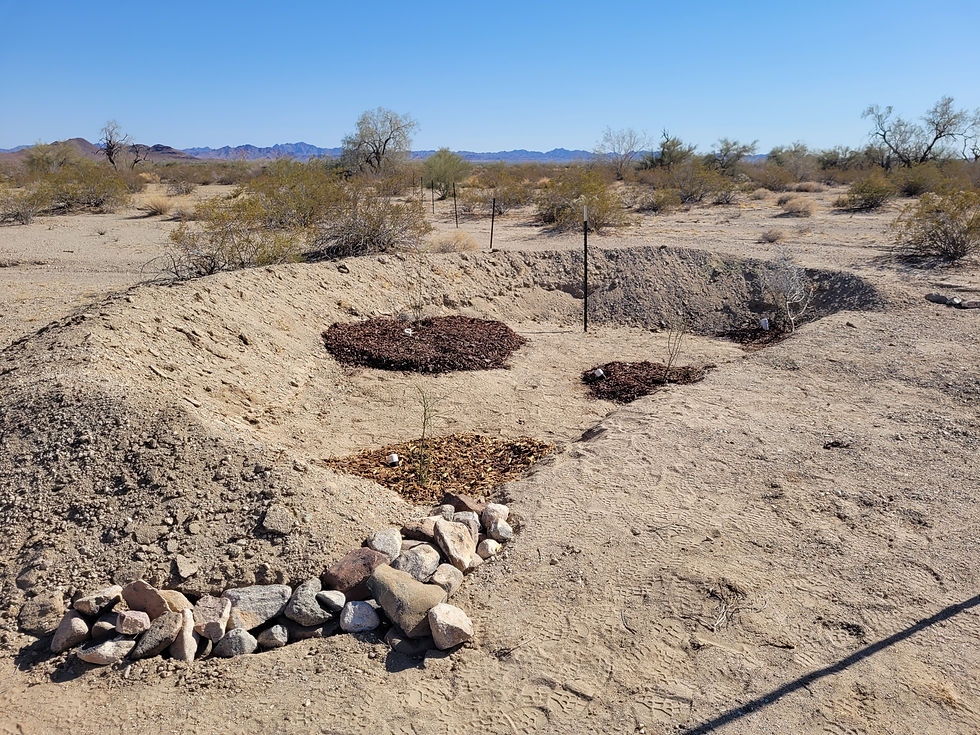
Despite the heat and the unsettling discovery, I still managed to move the project forward in small, concrete ways on this trip.
I installed four additional fence posts, slowly extending the defined boundaries of the site. Fence posts aren’t just about property lines; they also help guide where future paths, infrastructure, and plantings will go. They are another way of saying, “This place is being claimed for care.”
I also continued work on the second earthwork—more digging, more shaping, more attention to how water moves across the land. Every shovel full is part of a larger picture: intercepting sheet flow, slowing runoff, increasing infiltration, and gradually building soil moisture in a place that desperately needs it.
Rocks were added to reinforce existing structures, stabilizing edges and giving the earthworks more durability against wind and sporadic heavy rains. Mulch was spread around tree basins to help lock in what little moisture is available and protect roots from the relentless sun.
None of these actions are dramatic on their own. But permaculture, especially in a dryland context, is about cumulative effect. A tree here, a berm there, a rock at just the right spot—all of these slowly add up to a system that, one day, will look and function very differently than this harsh, exposed starting point.
Holding All of It at Once
If I had to summarize this trip in a few words, it would be: intensity, vulnerability, and commitment.
The intensity came from the heat—those triple‑digit temperatures that force both body and mind into a new level of respect for what “spring” now looks like.
The vulnerability came from the realization that the land is not only under pressure from climate stress, but also from very direct, very careless human activity. Standing alone on that land, hearing the rumble of dump trucks not too far away, I felt the precariousness of trying to do something healing in a place where others are doing something destructive.
The commitment is what remains after all of that: the decision to keep going, to adapt, to learn, to advocate. To refine my personal heat‑management strategies. To design more intentionally with shade and microclimate in mind. To continue reporting and pushing back against harmful activities when I find them. And to keep returning to Sleepy Mesquite, trip after trip, even when the progress feels slow and the challenges feel very large.
This land and this project are long‑term endeavors. There will be more heat. There will be more hard days. There will also be more small victories: a tree that pulls through a brutal summer, an earthwork that holds water exactly as designed, a day when the site feels slightly more alive than it did the year before.
For now, I carry forward what this April trip taught me: the value of shade, both natural and created; the reality of working in extreme heat; the need for vigilance and advocacy; and the quiet satisfaction of driving away from the land knowing that, even in a difficult visit, something was improved.
Sleepy Mesquite is still in its early chapters. This was a tough one—but it’s part of the story.

Comments