Sleepy Mesquite update 1-16-25
- David Herold
- Dec 18, 2025
- 6 min read


This month’s visit to Sleepy Mesquite was marked by companionship, steady progress, and the quiet persistence of winter in the desert. For the third time, Mark joined me out on the land, and his help was much appreciated. There’s something about working alongside another person that changes the rhythm of the day—tasks seem lighter, the hours pass more quickly, and the land itself feels a little less lonely.
Mark had his own motives for making the trip, of course. He was eager to test his new Cyber truck’s off-road capabilities, imagining how it might perform in a survival situation. The truck handled the rough terrain with ease, though it proved less than ideal as a place to sleep. We both had a good laugh about that—sometimes, even the most advanced technology can’t compete with a simple bedroll under the stars.
Building and Improving the Earthwork
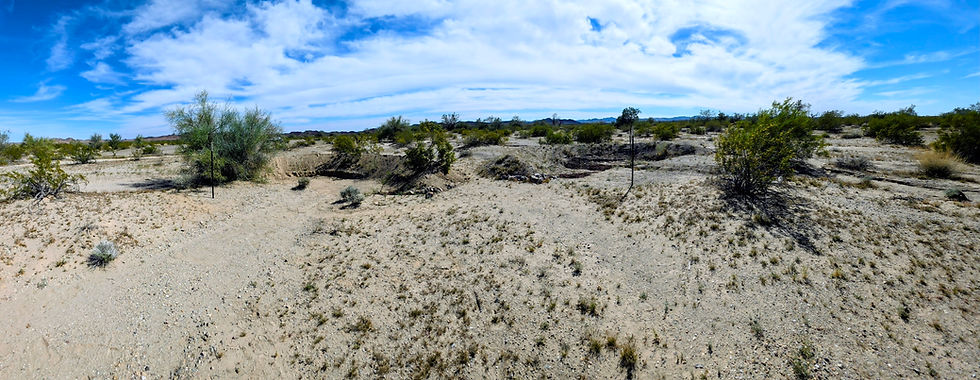
With Mark’s help, we were able to haul out a significant number of rocks from the surrounding area. These rocks became the building blocks for improvements to the first earthwork—a project that has become central to my efforts at Sleepy Mesquite. The earthwork is designed to capture and hold precious rainwater, slowing its flow and allowing it to soak into the ground rather than running off and taking valuable topsoil with it.

This time, we focused on constructing a series of one-rock-high check dams. These small barriers are deceptively simple, but they play a crucial role in slowing down the build-up of silt when the next rains come. By interrupting the flow of water, the check dams encourage sediment to settle out, gradually building up fertile soil behind each barrier. It’s a slow process, but one that pays dividends over time—each rain event brings a little more life to the land.
The work was physical, demanding, and deeply satisfying. There’s a kind of meditative quality to moving rocks, shaping the earth, and watching the landscape respond to your efforts. With each dam we built, I felt a sense of accomplishment—a small victory in the ongoing battle against erosion and desertification.
Finishing the Silt Removal and Planting the Third Tree
One of the lingering tasks from previous trips was the removal of silt from the first earthwork, a job made necessary by the aftermath of tropical storm Hilary. With Mark’s help, we were finally able to finish digging out the last of the silt, restoring the basin to its intended shape and function. It was hard work, but the sense of completion was palpable.

With the earthwork cleared, we turned our attention to planting the third tree—a hardy Mesquite, chosen for its resilience and ability to thrive in harsh conditions. We planted it in the same manner as before, digging a generous hole, amending the soil, and watering it in carefully. Each tree feels like a promise to the future, a living testament to the idea that restoration is possible, even in the most challenging environments.
As I watched the new Mesquite settle into its place, I was reminded of the first tree we planted, now a month into its life on the open desert. Despite the cold winter nights and the absence of rain, it continues to do well, its leaves green and its branches reaching skyward. These small successes are what keep me motivated, even when progress feels slow.
Placing Boundary Fence Posts: Defining the Space
Another important task this trip was the placement of four more boundary fence posts. As before, we set two posts on the north border, marching eastward, and two more on the west border, heading south. Each post was spaced twenty feet apart, creating a clear and orderly line that defines the edges of Sleepy Mesquite.
Boundary work is more than just a matter of property lines—it’s about creating a sense of place, a space where restoration can happen. The posts serve as physical markers, but they also represent the edges of possibility, the places where cultivated intention meets wild potential. Over time, these boundaries will become transition zones, rich with biodiversity and resilience, as the edge effect encourages life to flourish at the margins.
Evening Fellowship and Stargazing
As the sun dipped below the horizon, Mark and I settled in for the evening. We cooked our meals over a simple camp stove, shared stories, and watched the star-studded sky above. The desert night is a thing of beauty—clear, cold, and filled with the quiet hum of life. We were lucky enough to see a few meteorites shoot across the sky, brief flashes of light that reminded us of the vastness of the universe and our small place within it.
Having a companion on this trip made all the difference. The work felt lighter, the conversation richer, and the sense of community stronger. Restoration is often a solitary pursuit, but moments like these remind me of the importance of fellowship, of sharing the journey with others.
Mark’s Cyber truck Experiments: A Survival Gadget in the Desert

Mark, ever the tech enthusiast, spent some time testing his Cyber truck’s survival features. He ran a propane generator for nearly eight hours, hoping to charge the truck’s battery. In the end, the battery had only gained one percent—a total waste of LP gas, but an experiment worth trying. At night, Mark kept his cab temperature at a comfortable 71 degrees, losing just one or two percent of battery. Not bad, all things considered.
Mark’s approach to survival is gadget-oriented, always looking for the next innovation or tool that might make life easier. I, on the other hand, prefer simplicity—less to break, less to worry about. Our contrasting styles made for some interesting conversations, and I appreciated the insight Mark gained from testing his truck in these ways. It’s good to know what works and what doesn’t, especially in a place as unforgiving as the desert.
The Land’s Resilience: No Rain, Steady Growth
Once again, there was no rain this past month. The sky remained clear, the air dry, and the land unchanged except for the work we performed. Despite the cold winter nights, the trees continued to do well, their roots reaching deep into the soil in search of moisture. The absence of rain is a challenge, but it’s also a reminder of the resilience required to thrive in this environment.
Not much had changed from the previous month, but the steady progress we made was enough to keep hope alive. Restoration is a slow process, shaped by patience, persistence, and the willingness to celebrate small victories.
Conclusion: Reflections on Progress, Community, and the Journey Ahead
As I reflect on this trip, I’m struck by the importance of steady effort and the value of community. The work at Sleepy Mesquite is demanding, often slow, and sometimes frustrating, but it’s also deeply rewarding. Each rock moved, each tree planted, each boundary marked is a step toward a healthier, more resilient landscape.
Having Mark along for the journey was a gift. His help made the work easier, his company made the evenings brighter, and his experiments with the Cyber truck added a layer of interest to the trip. Our contrasting approaches—his love of gadgets, my preference for simplicity—created a balance that enriched the experience.
The land itself continues to teach me important lessons. Restoration is not a linear process; it’s shaped by cycles of disturbance and renewal, by the interplay of human intention and natural forces. The absence of rain is a challenge, but it’s also an opportunity to learn, adapt, and prepare for the future.
Looking ahead, I know there will be more challenges—more silt to clear, more trees to plant, more boundaries to mark. But with each trip, the vision becomes a little clearer, and the land a little more alive. The journey is long, but it’s one worth taking, step by step, stone by stone, tree by tree.
As I pack up my tools and prepare to leave Sleepy Mesquite, I feel a sense of gratitude—for the land, for the lessons, and for the companionship that made this trip special. Restoration is a journey, not a destination, and I’m grateful for every moment along the way.
Thank you for following along, and for sharing in the work of restoration. Until next time, may we all find strength in the slow, steady progress of nature—and in the care we give to ourselves and the world around us.

Comments