
Sleepy Mesquite Field Notes — 03/14/2026


Date & quick summary (03/14/2026)
I arrived on the property around 10:00am and worked across two days. This update covers: four fence posts set (two on the north property line and two on the west), a second mesquite planted in the second earthwork pit with a deep watering pipe and a protective cage, water hauled in ten 3.5-gallon stackable interlocking jugs, wood chip mulch refreshed (especially around the new tree), the first dome foundation footprint started (12-foot diameter), and a survey/stake-out of the third earthwork (no digging yet).
It was a practical trip—more about placing anchors than chasing big visible transformations. The kind of work that makes the next visit easier because the site becomes more legible: lines marked, points established, and one new structure finally given a real outline on the ground.
Weather & seasonal feel
Since the last update, at least one rain event came through—tracked remotely via local weather stations rather than witnessed directly. The total was about 0.1 inches. That’s not a soaking storm, but it’s enough to change the surface story: mulched areas darken, bare soil shows where it seals, and the earthworks reveal their flow lines more clearly.
Temperatures have dropped slightly since the last trip, but it’s still warmer than normal for this time of year. That combination creates a strange tension: the air feels a little kinder, yet the sun still pushes hard in the afternoon. It’s the kind of weather where you can do careful work if you pace yourself, but you can also get dehydrated without noticing until you’re already behind.
Insects & small life
Insect activity continues, but it’s less intense than earlier as summer approaches. Beetles and ants were the main presence—steady and everywhere. I also saw some wasps and flies, and a few grasshoppers, but not as many as last time.
I’m starting to treat these observations as part of the site’s feedback system. Ant trails show me where the ground stays cooler or where there’s something worth harvesting. Beetles show up where organic matter is doing its slow conversion into soil. The reduced grasshopper pressure is a relief, but I’m not assuming it’s permanent—just noting the current balance.
Arrival & first walk (10:00am)
Before I touched tools, I took a short walk to re-orient. I like to do that even when I’m eager to start. The land always has a few quiet updates: where the wind has moved debris, where the soil surface has crusted, where mulch has settled, and where the light falls at this time of year.
The slight temperature shift was noticeable right away. The ground didn’t feel as brittle on the surface, and the mulched zones held onto a darker tone that suggested they’d captured what little moisture the rain event offered. Even a tenth of an inch becomes meaningful when you’re trying to build a system that can hold onto small gifts. Despite the rain the grasses are starting to brown a bit.
Fence line progress (north + west property lines) — ~30 minutes
I started with fence posts because they’re a clean way to build momentum: physical, measurable, and immediately useful. Two posts went on the north property line and two on the west. The work took about 30 minutes—no drama, mostly soft sandy soil, which is a gift when you’re trying to keep a line straight and your energy reserved for harder tasks later.
For placement, I used a simple post hammer, a 100-foot spooled tape measure, and a lens Matic compass. The tape keeps spacing honest; the compass keeps me from drifting when the terrain tries to pull the line off course. I’m learning that ‘close enough’ becomes ‘noticeably wrong’ once wire is run, so I’m trying to be precise early when corrections are cheap.
Even four posts split across two edges changes how the site reads. The north line starts to feel like a defined boundary rather than an imagined one. The west line becomes easier to navigate mentally when I’m planning future movement and protection zones.
Second earthwork: planting the second mesquite (5-gallon container) — ~30 minutes
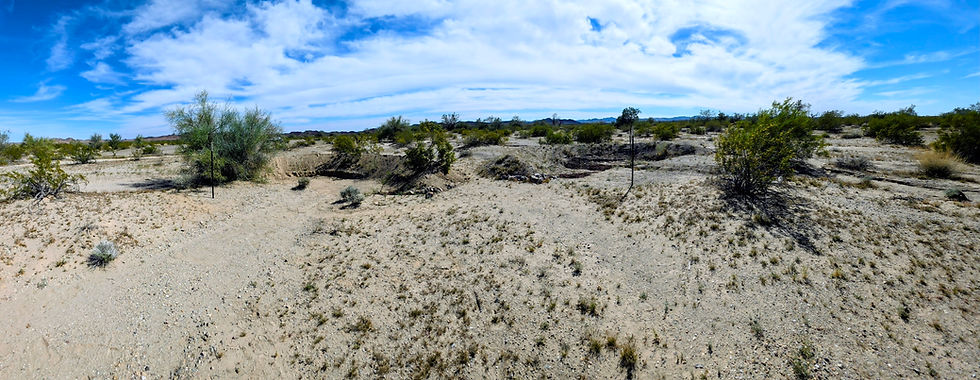
Planting took about 30 minutes. The second mesquite was a 5-gallon container tree, planted in the pit of the second earthwork—down where water should naturally collect and linger longer than it does on the surrounding grade.
I amended the planting hole with standard bagged topsoil. I’m aware of the tradeoffs with amendments—how they can create a ‘pot effect’ if the surrounding soil is very different—but in this context I’m using it as a bridge: a way to give the young tree a more forgiving start while the surrounding soil continues to improve under mulch and time.
Next to the tree, I installed a two-foot-long deep watering pipe. That pipe is part of the establishment strategy: it lets me deliver water below the surface where evaporation is lower and where roots are encouraged to chase moisture downward. Surface watering can keep a tree alive; deep watering helps it become independent.
I also placed a cage around the tree to protect it from deer and rabbits. There weren’t any new wildlife signs this trip that changed my thinking, but the cage is still non-negotiable for a young planting here. It’s not just protection—it’s time. It buys the tree a few seasons to establish before it has to negotiate with browsing pressure.

Mulching: wood chips only — ~30 minutes
Mulching took about 30 minutes. I stick with wood chip mulch because it’s heavier, less likely to blow away, and slower to decompose. In a windy, sun-heavy environment, those traits matter. I’d rather build a stable surface layer that persists than chase lighter materials across the property after every gust.
Around the new mesquite, I laid wood chips about six inches deep in a three-foot diameter ring around the base. I didn’t cover paths or berms this trip—this was targeted mulching focused on establishment and moisture retention right where the tree needs it.
Wood chips also create a more stable habitat layer. Even when above-ground insect activity feels reduced compared to earlier in the season, the mulch layer stays active. It’s where moisture lingers, where temperature swings are softened, and where decomposition can proceed at a steady pace.

Water haul & deep watering at dusk — 10 jugs, over an hour
Watering took over an hour and happened at dusk. I hauled water in ten 3.5-gallon stackable interlocking brick-style jugs—35 gallons total. I like these jugs because they pack well, don’t roll around, and make the volume easy to track.
The new trees got three jugs total (about 10.5 gallons). The more established trees got less. That distribution is intentional: new plantings need deeper, more deliberate watering to encourage roots to chase moisture downward; established trees can take smaller maintenance drinks, especially when mulch is doing its job.
The deep watering pipes slow the process in a good way. I had to wait for the pipes to empty out between fills, which forced patience and prevented me from dumping water too quickly. It’s easy to ‘water’ in a way that mostly runs off or evaporates. Deep watering is slower, but it’s more honest.
Dusk watering also feels right out here. The air cools, evaporation drops, and the site gets a longer window to absorb what you bring. It’s a small scheduling choice that makes each gallon go further.
First dome structure: foundation footprint (12 ft diameter) — 3 hours on day 2
On the second day, I spent about three hours starting the foundation excavation for the first dome structure. The planned diameter is 12 feet. The site sits about 25 meters southeast of the first earthwork.
The dome area is relatively flat with about a one-degree slope to the south. The soil is what I can only describe as a rocky desert asphalt—dense, stony, and stubborn, with depth still to be determined. Digging six inches down in that material is slow work. Every inch feels earned.
I marked the circle with stakes. There’s something satisfying about seeing a clean circle appear on real ground. It turns a future structure into a present place. Even before the foundation is poured, the footprint changes how you move through the area and how you imagine the site’s next phase.
The foundation style I’m aiming for is a poured sandstone monolithic approach. I’m intentionally not going deep into the method here—I’ll save the details for a future post—but the excavation itself is the first commitment. It’s where accuracy matters: a circle that’s slightly off now becomes a bigger problem later when everything stacks upward.

Third earthwork: surveyed and staked (no digging yet)
I also surveyed and staked out the third earthwork. No digging yet—just layout. That kind of work can feel invisible, but it’s important. Staking is where you test an idea against the actual land: slope, spacing, access, and how the new feature will relate to what’s already built.
I’m glad I did it on this trip, even without breaking ground. It keeps the next phase from being purely theoretical. The stakes are a reminder that the project is moving forward in layers, not leaps.
End-of-day feeling
By the time I packed up, the changes were subtle but real: two edges of the property had new anchors, the second mesquite was planted with protection and deep watering in mind, the mulch ring around it was thick and stable, water had been delivered slowly and deliberately at dusk, the dome footprint existed as a staked circle with the first six inches of excavation started, and the third earthwork had been brought out of imagination and into layout.
This is the kind of progress I trust. It’s not flashy, but it’s structural. It’s the work that compounds.
Next steps (for the next trip)
• Continue the dome foundation excavation and confirm final grade. • Check the new mesquite for settling; adjust the cage and refresh the mulch ring if needed. • Keep extending wood chip mulch in the most exposed zones. • Plan the next fence run for the north and west lines. • Re-walk the third earthwork stakes and confirm the layout before any digging begins.
Closing note
Remote rain data, warmer-than-normal temperatures, and a shifting insect mix all formed the backdrop for this trip. The work itself was straightforward: define edges, establish a tree, protect moisture, and begin a structure. I’ll take straightforward over dramatic any day—especially when the land is the long game.
Field log: the rhythm of waiting (deep watering pipes at dusk)
The deep watering pipes change the tempo of watering in a way I didn’t fully appreciate until I committed to using them consistently. You can’t rush them. You fill, you wait, you watch the level drop, you fill again. That waiting time becomes part of the workday rather than a pause from it.
At dusk, that rhythm feels almost ceremonial. The light softens, the wind often calms, and the site becomes quieter. The insects that are active at that hour have a different feel than the midday flyers. Ants keep moving. Beetles keep doing their slow patrols. The air cools enough that you can feel the difference between sun-heated surfaces and shaded ones.
While the pipes emptied, I found myself scanning the ground for small signs: where water had darkened the soil near the pipe, where mulch had settled into a tighter mat, where the surface crust on bare soil resisted infiltration. It’s not that I was trying to turn watering into a science experiment; it’s that the waiting creates space for noticing.
Tools & navigation: tape, compass, and keeping lines honest
A 100-foot spooled tape measure is one of the most underrated tools on a property like this. It’s not just for distance; it’s for discipline. It keeps you from eyeballing spacing and calling it good. It keeps you from drifting when the terrain subtly pulls you off line.
The lens Matic compass plays a similar role. It’s easy to think you’re walking straight until you look back and realize you’ve been following the path of least resistance rather than the path you intended. The compass is a way of checking myself. It’s not about perfection; it’s about preventing cumulative error.
Post placement went smoothly this trip—soft sandy soil, no problem holes, no wrestling with stones. That ease is worth noting because it’s not guaranteed. Some days the ground makes you pay for every inch. Today it let me move quickly and save energy for the dome excavation, where the soil did the opposite.
Soil contrast: sandy post holes vs. rocky dome ground
One of the clearest contrasts of the trip was the difference between the soil along the fence lines and the soil at the dome site. The fence post holes were mostly soft sandy soil—easy to work, forgiving, and quick. The dome site, by contrast, felt like a compacted, rocky crust—what I called ‘desert asphalt’ because it behaves like a thin pavement made of stone and stubbornness.
Digging six inches into that material took three hours. That’s not because I was moving slowly; it’s because the ground demanded it. Every shovel bite hit rock. Every small pocket of looseness was surrounded by resistance. It’s the kind of digging that makes you appreciate layout work, because you don’t want to excavate more than you have to.
It also changes how you think about foundations. A monolithic poured sandstone foundation will need a clean, consistent base. The soil is telling me that preparation will be the real work. The pour will be the reward.
Planting choices: 5-gallon mesquite and a ‘bridge’ amendment
The mesquite went in as a 5-gallon container, which feels like a good compromise between establishment potential and transplant shock. Smaller trees can establish quickly but are more vulnerable; larger trees have more stored energy but can struggle if roots are constrained.
I amended with bagged topsoil as a bridge rather than a permanent solution. The surrounding soil is still in the process of becoming more hospitable through mulch and time. The amendment gives the tree a softer start while the system catches up.
The deep watering pipe is the other half of that strategy. If the amendment is the short-term comfort, the pipe is the long-term training. It’s how I encourage the tree to build the kind of root system that can survive the hotter months without constant intervention.
Staking the third earthwork: planning without disturbance
Surveying and staking the third earthwork was a different kind of satisfaction. There’s no immediate visual payoff like there is with digging, but there’s clarity. Stakes turn a vague future feature into a specific shape you can walk around.
I like doing layout work before I’m ready to dig because it gives the idea time to sit on the land. You can come back later and see if it still feels right. You can notice whether the stakes align with natural flow lines, whether access makes sense, and whether the feature will interfere with other plans.
No digging yet means no disturbance yet. That’s a win in itself. Disturbance is sometimes necessary, but it’s always a cost. Staking lets me delay that cost until I’m more certain.
Evening wrap-up: what I want to remember next time
When I think about what I want to carry into the next trip, it’s not just the task list. It’s the context: the dome soil is rocky and slow; the fence lines were easy this time; the deep watering pipes require patience; the new mesquite has a six-inch wood chip ring and a cage that needs periodic checking; the third earthwork is staked and waiting.
Those details matter because they shape how I pack, how I pace, and what I prioritize. They also shape expectations. If I show up expecting the dome excavation to move quickly, I’ll get frustrated. If I show up expecting the watering to be fast, I’ll rush it and waste water. The field notes are how I keep myself honest.
Extended narrative: moving between zones
One thing that stands out when I work across multiple zones in a single trip is how each zone asks for a different mindset. The fence lines are about geometry and boundaries. The earthwork pit is about water behavior and establishment. The dome site is about precision and patience in difficult ground. The third earthwork stakes are about imagination disciplined by measurement.
Moving between these zones keeps the day from becoming monotonous, but it also forces transitions. You finish a task, you reset your attention, you pick up a different tool, and you let the next area tell you what it needs. That transition time is easy to ignore when you’re planning, but it’s real. It’s part of why a day can feel full even when the task list looks short.
I noticed that the site feels more connected now than it did earlier in the project. The dome location isn’t isolated; it relates to the first earthwork by distance and orientation. The second earthwork isn’t just a feature; it’s becoming a planting zone with its own maintenance rhythm. The fence lines aren’t just boundaries; they’re becoming reference edges that help me navigate and plan.
That sense of connection is subtle, but it’s important. It’s what turns a collection of projects int
o a system.
Want a permaculture system that compounds like this—clear boundaries, water-holding earthworks, and resilient plantings? Book a Permaculture Design & Consulting session and we’ll map your next practical anchors.
Get the monetized edition of this field note—expanded build details, exact measurements, materials list, and what I’d do differently next time. Unlock the full post now.

Comments