Sleepy Mesquite update 2/28/2026

Sleepy Mesquite update 2/28/2026
I’m writing this one a little more like a field journal, because this trip had that feeling of a turning point—one of those visits where you can finally see the master plan starting to show up on the ground in a way that’s hard to ignore.
The work list was simple on paper: keep moving the fence line forward, finish the second earthwork, start planting it, and take care of the trees that are already in the ground. But the desert always adds its own agenda—weather, heat, wind, and whatever is crawling, flying, or blooming at the moment.
Fence posts: slow work that changes everything
I continued placing 4 additional fence posts on this trip. Fence work is one of those tasks that doesn’t look like much in a photo until you step back and realize it’s literally drawing the boundary of what’s possible.
Every post is a decision: where the line runs, how the land will be managed, what gets protected, and what gets invited in. It’s not glamorous work. It’s measuring, digging, tamping, checking alignment, and doing it again. But it’s foundational.
I’ve learned to treat fence posts like punctuation marks in the story of a property. You don’t write the whole book in one sitting—you place the next mark, then the next, and eventually the sentence becomes readable.
Earthwork #2: finished, shaped, and finally ready to receive life
The big win of the trip was finishing the second earthwork. The first earthwork taught me a lot—mostly about how the land wants to move water, and how my ideas need to be humble enough to follow that.
This second one went smoother. I had a clearer sense of the grade, the flow, and the little adjustments that make the difference between an earthwork that looks good and an earthwork that actually functions.
When I say ‘finished,’ I mean the shape is there: the berm is built, the basin is defined, and the whole thing reads like a piece of the landscape instead of a scar across it.
Earthworks are funny that way. At first they look like disturbance. Then, after a few storms and a little settling, they start to look inevitable—like they were always supposed to be there.

Planting the second earthwork: the first mesquite goes in
I also began planting the second earthwork with its first mesquite tree.
Mesquite is one of those species that feels like a teacher. It’s tough, it’s patient, and it doesn’t waste energy. It’s built for this kind of place.
Planting the first tree into a new earthwork is a ceremonial moment, whether you call it that or not. It’s the moment the earthwork stops being just a water-harvesting structure and becomes habitat—something that will cast shade, drop leaf litter, feed soil life, and change the microclimate.
I took my time with the planting. I wanted the tree to sit right, to have a good basin, and to be set up for the long game. In dry land work, the long game is the only game.
Mulch and water: the unsexy maintenance that keeps the dream alive
I spread out an additional 4 bags of mulch around the trees and watered them.
Mulch is one of the best ‘technologies’ we have. It’s simple, but it changes everything: it buffers temperature swings, slows evaporation, protects soil structure, and feeds the fungal side of the soil food web.
In a place where the sun can feel like it’s trying to erase your work, mulch is a way of saying, ‘Not today.’
Watering was straightforward, but I stayed mindful of how the water moved. I’m always watching for where it wants to pool, where it wants to run, and where it disappears too fast.

Winter storms and a landscape that finally turned green
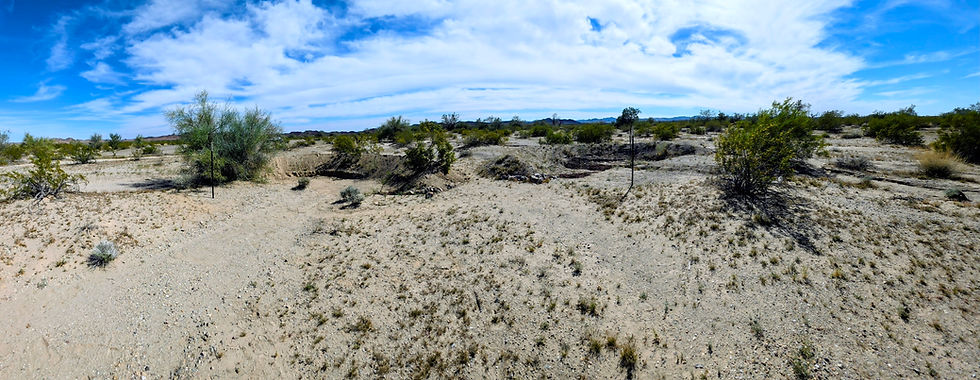
There were several winter storms that had passed through the property since my last visit, and as a result there was lots of green grass and flowers to be had.
It wasn’t a thick carpet of green—more like a thin, scattered veil across the landscape—but it was still more grass than I had ever seen before out there.
For the last 5 years I had been spreading bags of Sonoran native grass seeds and until now saw little growth as a result.
That’s the part people don’t always understand about restoration work: you can do the right thing for years and see almost nothing. Then one season comes along where the timing is perfect—rain at the right moment, temperatures that don’t swing too hard, maybe a little less wind—and suddenly the land answers.
This year the conditions were just right for the seeds to grow. It felt like the property was saying, ‘Okay, I’m ready now.’
It’s a good reminder that patience isn’t passive. Patience is active. It’s showing up, doing the work, and trusting that the right conditions will arrive eventually.
Heat: 103 degrees in the middle of a green year
Despite the lush growth from the winter storms, I was having to contend with 103 degree temperatures during my stay.
That kind of heat changes the rhythm of everything. You don’t ‘push through’ it—you negotiate with it.
I took frequent breaks and poured water on myself throughout my 2 day stay. That wasn’t dramatic; it was just practical. When the air is that hot, your body becomes another system you have to manage.
The desert can be generous, but it’s not sentimental. It will let you work, but it will also punish you if you pretend you’re tougher than you are.
Cold nights: low 50s and the desert’s daily reset
The nights were cold in the low 50s.
That swing—from triple-digit afternoons to cold nights—is part of what makes desert ecology so unique. It’s also part of what makes desert camping feel like you’re living inside a lesson.
At night, everything quiets down and resets. The heat drains out of the soil. The sky opens up. And you remember that the desert isn’t empty—it’s just operating on a different schedule.
Insects: loud evenings, quiet afternoons
Insect life was still very active despite the heat, but noticeably less so later in the afternoon.
In the evening hours the insects became quite loud, which was unusual for the desert.
Usually you can hear a mouse fart 10 miles away out there. That’s the kind of quiet I’m used to.
But this time, the evenings had a chorus. It felt like the land was celebrating the moisture while it lasted.
The dump site: documenting the eyesore
I also revisited the dump site and took pictures of it this time.
It’s a 6 feet tall wall about 50 yards long of what looks like a demolished house or homestead. A real eyesore on the landscape.
I’ve walked past it before, but this time I wanted to document it—partly for my own records, and partly because it’s a reminder that land carries history, and not all of it is pretty.
There’s a temptation to ignore things like that and focus only on the beautiful parts. But permaculture is about working with reality, not fantasy.
The dump site is part of the reality. It’s also a future project—one that will take time, planning, and probably a lot of hauling.

Master plan progress: small steps that add up
Each visit is showing more progress on the implementation of the master plan.
That’s the part that keeps me coming back. Even when the work is slow, even when the heat is brutal, even when the to-do list feels endless—there’s always something that moves forward.
Four fence posts. One finished earthwork. One mesquite planted. Four bags of mulch. A little more water in the soil. A little more green on the land.
Those are small things in isolation. But stacked over time, they become transformation.
Closing thoughts
All and all, a very productive trip.
I left tired, sun-baked, and satisfied—the good kind of tired that comes from doing work that matters.
The land is responding in its own time. The seeds waited for the right conditions. The storms came through. The grass showed up. And the master plan is slowly becoming something you can walk through, not just something you can imagine.
Field notes
One thing I keep noticing is how the smallest changes in topography create completely different outcomes. A shallow depression holds moisture for days longer than the surrounding ground. A slight rise dries out faster and becomes a different plant community. When you’re out there long enough, you start reading the land like a map that’s written in water.
That’s why earthworks matter so much. They’re not just about catching runoff. They’re about creating opportunities—little pockets where life can get a foothold. In a wetter climate you can get away with sloppy design. In dry land, the margin for error is smaller, but the payoff is bigger when you get it right.
Finishing the second earthwork felt like finishing a sentence I started a long time ago. The first earthwork was the rough draft. The second one is the revision—still not perfect, but more aligned with what the site is teaching me.
I spent time walking the berm and basin, looking at it from different angles, imagining how water will enter during a storm, where it will slow down, where it might overflow, and how that overflow should be directed. I’m always thinking about the next storm, because storms are the real project managers out there.
Planting the mesquite into the second earthwork also made me think about succession. Mesquite is a pioneer in a lot of ways, but it’s also a nurse. It creates shade and fertility that other species can use later. I’m not planting a single tree—I’m planting the beginning of a community.
I’m also paying attention to how the mulch behaves. In some spots it stays put. In others, wind wants to rearrange it. Mulch is a conversation with gravity and wind. You put it down, and then you see what the site does with it.
The green growth from the winter storms was the emotional highlight of the trip. It’s hard to describe what it feels like to see grass where you’ve been scattering seed for years with almost nothing to show for it. It’s not just ‘nice.’ It’s confirmation that the system can respond.
I don’t take that lightly. I know a single good year doesn’t mean the work is done. But it does mean the seed bank is there. It means the potential is there. And it means that when the timing is right, the land can still surprise you.
The flowers were scattered, but they were there—little bursts of color that made the whole place feel less harsh. Even thinly spread out, they change the mood of the landscape. They also bring in pollinators, which brings in more life, which brings in more complexity.
The heat was no joke. 103 degrees is the kind of temperature that makes you respect shade like it’s a sacred thing. I planned my work around the sun, and I kept reminding myself that the goal is progress, not punishment.
Pouring water on myself sounds funny, but it’s one of the simplest cooling strategies when you’re working in dry heat. Evaporation does the work. You just have to keep enough water on hand to do it safely.
At night, when it dropped into the low 50s, it felt like the desert was giving me a reset. I slept better than I expected. There’s something about being tired from real work that makes sleep come easy.
The insect chorus in the evenings was one of the strangest and best surprises. It made the place feel alive in a way I’m not used to hearing out there. Usually the desert is quiet enough to make you hear your own thoughts too clearly.
The dump site is still a thorn in my side. It’s hard to look at a wall of debris and not feel a little anger—at the waste, at the disregard, at the way someone treated the land like a trash can. But anger doesn’t clean it up. Documentation is the first step. Planning is the second. Then, eventually, action.
I’m trying to hold the long view. The master plan isn’t a checklist I’m racing through. It’s a relationship I’m building with a place. And relationships take time.
When I say ‘master plan,’ I don’t mean something rigid. I mean a guiding pattern: water first, access second, structures and boundaries, then planting, then refinement. The order matters. If you plant before you manage water, you spend your life hauling water. If you manage water first, the land starts doing some of the work for you.
This trip felt like a good example of that order. The earthwork is finished. The first tree is planted into it. The mulch is down. The storms already proved the site can green up. Now the job is to keep stacking functions and keep showing up.
I left the property thinking about the next visit. There’s always a next step: more posts, more planting, more observation, more small corrections. But for once, I also left feeling like I could point to the landscape and say, ‘Look—this is working.’
What I’m learning (and re-learning) out here
Every trip out to Sleepy Mesquite has a work list, but it also has a lesson list. Sometimes the lessons are obvious—like ‘don’t underestimate heat’—and sometimes they’re subtle, like noticing how a patch of grass chooses one side of a micro-swale and ignores the other.
This visit, the big lesson was timing. I’ve been spreading Sonoran native grass seed for years. I’ve watched wind take it, birds take it, and drought ignore it. And then, when the storms lined up just right, the land finally said yes.
That’s the part that can make you either cynical or committed. If you need instant feedback, dry land will break your heart. If you can work with delayed results, it will teach you a kind of faith that’s grounded in observation.
Earthworks as ‘infrastructure’
I think a lot of people hear ‘earthwork’ and imagine a big dramatic construction project. Sometimes it is. But most of the time it’s just shaping the land so water has a better chance of doing what it already wants to do: slow down, spread out, and soak in.
In that sense, earthworks are infrastructure—like roads or plumbing—but for ecology. They’re the hidden systems that make everything else easier.
Finishing the second earthwork felt like installing a new piece of infrastructure that the site can use for decades. The berm will settle. The basin will collect organic matter. The planted mesquite will grow roots deep enough to find moisture long after the surface looks dry.
Heat management: working with the day instead of against it
103 degrees forces you to be strategic. I worked early, slowed down mid-day, and picked up again when the sun started to lose its edge.
I kept water close, not just for drinking but for cooling. I’d wet my hat, wet my shirt, and take a break in whatever shade I could find or create.
It’s easy to romanticize hard work, but the truth is: the desert doesn’t reward bravado. It rewards consistency. The goal is to come back again and again, not to win a single weekend by burning yourself out.
The dump site: future remediation
Taking pictures of the dump site was my way of acknowledging it as a real design element—an unwanted one, but still something that affects the property. even though its over 1/2 a mile away.
It’s a reminder that restoration isn’t only about planting trees and catching water. Sometimes it’s about undoing damage that someone else left behind. It can also be a potential source of resources in the future.
I don’t have a perfect solution yet, but I’m thinking in phases: document, assess what’s actually there, figure out what can be removed safely, and then decide what the long-term plan is for that area.
Closing the loop
When I look back at the last few years, the progress is real—even if it’s been slow. The fence line is advancing. The earthworks are multiplying. Trees are getting established. Mulch is building soil. And now, finally, the grasses are showing up.
That’s the loop: water harvesting supports plants, plants support soil, soil supports more plants, and the whole system becomes more resilient.
I’m not trying to force the desert to be something it isn’t. I’m trying to help it express its best self.
A longer walk-through of the trip
Day one started with that familiar feeling of stepping back into a place that’s both harsh and welcoming. The air had that clean desert smell, and the light was sharp enough to make every rock cast a shadow.
I did a slow walk first. I always do. Before I pick up a tool, I want to see what changed since the last visit. Where did water run? What sprouted? What died back? What looks stressed? What looks like it’s thriving?
The green was the first thing that hit me. Not everywhere, not thick, but present. Little patches of grass, scattered flowers, and that overall sense that the land had been drinking.
Then I got to work. Fence posts first. It’s repetitive, but it’s also satisfying. You set one, then another, and the line becomes more real. It’s like watching a sketch turn into a drawing.
After that, I focused on finishing the second earthwork. I shaped, adjusted, and checked the flow. I wanted it to be functional, not just ‘done.’
Planting the mesquite came next. I dug the hole, set the tree, and built the basin around it. I mulched heavy and watered slow, letting the water soak in instead of running off.
By mid-day, the heat was pushing hard. That’s when I shifted into maintenance mode: watering existing trees, spreading mulch, and doing smaller tasks that didn’t require as much exertion.
Day two was more of the same, but with more observation. I revisited the dump site, took photos, and tried to see it not just as an eyesore but as a design challenge.
By the time I packed up, I felt that familiar mix of exhaustion and gratitude. The work is never finished, but it’s moving forward.
Notes for future me (and anyone following along)
I’m adding this section as a set of notes—part reminder to myself, part explanation for anyone reading these updates and wondering why I keep talking about posts, mulch, and earthworks like they’re big milestones.
In dry land permaculture, the early years are mostly about setting the stage. You’re building the bones of the system: boundaries, access, water harvesting, and the first wave of hardy plants that can survive long enough to start improving conditions.
Fence posts matter because they protect investment. If you can’t control pressure from animals, vehicles, or people cutting across the land, you end up redoing the same work over and over.
Earthworks matter because water is the limiting factor. If you can catch even a small percentage of runoff and infiltrate it, you’re effectively increasing rainfall without changing the climate.
Mulch matters because soil is the engine. Without soil cover, the sun bakes the surface, biology shuts down, and every drop of water evaporates too fast. With soil cover, the system starts holding onto what it receives.
And planting a mesquite matters because it’s a long-term ally. It’s a species that can handle the conditions now, while also improving conditions for whatever comes next.
The green year matters because it proves the seed bank is alive. It proves that the land can respond when timing lines up. That’s huge.
I’m not expecting every year to look like this one. But now I know the potential is real, not theoretical.
Next steps are pretty clear: keep extending the fence line, keep building earthworks in the right sequence, keep planting tough pioneers, and keep feeding the soil with mulch and organic matter whenever I can.
And, eventually, I’ll have to deal with that dump site in a serious way. For now, it’s documented. It’s on the list. And it’s not being ignored anymore. even though its not really my problem. but it a good thought exercise.
Till next time, keep the dream alive, start small, and keep working the plan. Stay safe out there.


Comments