
Sleepy Mesquite updated 12/03/2025


As I journey toward Sleepy Mesquite, I can’t help but notice the lively atmosphere surrounding me. Each visit seems to reveal more wildlife than the last, serving as a delightful reminder of nature's endless bounty. The nearer I get to my cherished land, the more vibrant the scenery becomes.
Upon my arrival, the landscape is noticeably more dynamic than it was just a month ago. The foliage is richer, and the air is filled with the sounds of birds—more than I’ve ever observed on past visits. Their cheerful chirping provides a joyful soundtrack to the stunning surroundings.
Even the insects contribute, their distinct buzzing and chirping creating a lively backdrop. It’s a wonderful reminder of the intricate web of life thriving here, a clear indication that late fall has settled in.
As I continue to appreciate the natural world around me, it’s uplifting to witness this ongoing cycle of life. Each visit to Sleepy Mesquite deepens my connection to the land and its inhabitants. Here’s to more adventures and discoveries in this vibrant, ever-evolving landscape!
Observations and Tasks Ahead
On these trips, I have been anxious to see if the two dried-up Mesquite trees were showing any sign of returning to life. I was also looking forward to placing four more fence posts and continuing work on the second earthwork. The second earthwork needs more reinforcement as well as continued excavation work. The first earthwork is also getting additional reinforcement and a planting of a new Mesquite tree.
Reflections on the Rain
I observed upon my arrival that it had rained again on the property, enough to erase all my previous footprints in the ground. The soft earth, once marked by my passage, now lay smooth and untouched, as if nature had decided to wipe the slate clean. I took a deep breath, inhaling the fresh, earthy scent that lingered in the air, a reminder of renewal and the quiet power of the elements.
Observations of the Earthworks
As I walked around the site, the subtle signs of life were encouraging. The earthworks, while stable, seemed to be breathing a sigh of relief after the fall rains. The new herbaceous growth, with its vibrant greens, was a reminder of nature's resilience. It was particularly heartening to see it pushing through in the pit area, where the soil had been disturbed, and even on the berms, where it could help with stabilization.
Weather Patterns
The winter rains are usually gentle, almost timid, which makes it difficult to gauge how well the earthworks will hold up under more significant weather events. It's a bit of a waiting game. The absence of new silt in the pit is a positive sign, yet it also raises questions about how much runoff we might expect when the heavier rains finally arrive.
Future Considerations
Despite the current stability, I can't shake the feeling that more reinforcement is necessary. It's like preparing for an unpredictable guest—you want to be ready for anything. Perhaps additional drainage measures or structural support could provide that extra layer of security. After all, while the winter may be mild, we know that spring can bring its own challenges. In the coming weeks, I’ll need to assess the growth more closely and consider the best strategies for fortifying the site. It’s a delicate balance between letting nature take its course and ensuring that we’re prepared for what’s ahead.
Condition of the Mesquite Trees
I've noticed that the two Mesquite trees have deteriorated significantly. It's clear they need to be removed and added to the mulch. Thankfully, I brought a replacement tree for one of them. Interestingly, it seems that nature has already stepped in with a young Ironwood tree sprouting just a few inches away.
Fence Post Installation
The installation of the four new fence posts is crucial for defining the boundaries of the area.
Continued Work on Earthworks
For the second earthwork, I have outlined a strategy to enhance its structure:
Assess the current state and identify weak points.
Add additional soil and materials for reinforcement.
Continue excavation to deepen and expand the area as needed.
The first earthwork, which has been a priority, will also receive attention:
Reinforce existing structures with additional materials.
Plant the new Mesquite tree in a favorable location to promote growth.
Ensure proper watering and care for the newly planted tree.
Looking Ahead
As I continue with this project, I’ll keep in mind how important sustainability is and the potential for growth in this area. It's essential for me to focus on the well-being of the Mesquite trees and to preserve the integrity of the earthworks, as these factors are vital for the success of what I'm working on.
My Fence Post Installation Journey
Installing a fence post has turned into a calming ritual for me. What used to be a daunting chore has transformed into a comforting routine, where each action seamlessly leads to the next. As I gather my tools, the sunlight filters through the trees, casting a warm glow over the land, and I can’t help but feel a smile creeping onto my face, excited for the task ahead.
Getting Ready and the Process
It all starts with gathering my essential tools: a metal T post, a hammer, gloves and a tape measure. This preparation feels like gearing up for a performance, setting the scene for a smooth execution of my plan. Once everything is in place, I visualize where each post will go, using my line of sight to mark the spots without needing stakes or strings. now that I have enough post in to use line of sight.
With purpose, I position the T post and drive it into the earth with my hammer. Each strike is deliberate, and soon enough, the post stands firmly in place. I take a step back to check its alignment, making minor adjustments until it feels just right, marking a little victory in my day.
Then comes the moment of securing the post. I pause to ensure it stands straight and stable. A gentle shake reassures me of its strength, filling me with pride over this small achievement.
The Joy of Routine
With every installation, I realize how efficiency has become second nature. My hands know exactly what to do, as if the routine has been choreographed, and the rhythm flows effortlessly. Repetition has honed my skills, and each post I set showcases the lessons learned from the past. I can see the improvement in sturdiness and alignment, which boosts my confidence. There’s a comforting familiarity in knowing what to expect, turning the task from a chore into a gratifying project. Each post brings me closer to my vision for the fence.
As I step back to admire the first post standing tall, I can already picture the finished fence, a boundary that will hold memories of laughter and gatherings. Each post I install isn’t just part of a fence; it’s a step toward creating a space that feels like home, making this routine is all the more fulfilling.
A New Beginning for the Old Tree Pit
As I knelt beside one of the now lifeless trees, I felt a sense of responsibility weighing on my shoulders. With careful hands, I began to remove the mulch that had once cradled its base. To my surprise, I discovered that the spot where the tree had been planted was raised a good four inches above the surrounding soil. It was a revelation that made me ponder—could this unevenness have played a part in the tree's demise? Water likely struggled to reach its roots, leaving it thirsty and vulnerable compared to its neighbors. Realizing the need for change, I knew that more excavation was in order. I envisioned leveling the pit, creating a nurturing cradle for a new tree to flourish. It was essential to ensure that the next resident of this spot would have a fair chance at life, with a level and welcoming environment. Once the pit was evened out, my attention would turn to the soil itself. I planned to assess its quality meticulously, pondering whether it needed a little boost. After all, I wanted to set the new tree up for success. Perhaps organic matter would enrich it, or maybe I’d need to tweak the pH levels. Each decision would be made with care, as I envisioned the vibrant life that would soon take root here. With the soil prepared, I would embark on the quest of selecting a new tree. This wasn’t just any tree; it had to be the perfect fit for the unique conditions of this site. I considered the sunlight it would bask in, the drainage it would rely on, and the type of soil it would call home. Each factor weighed heavily in my mind as I sought the ideal companion for this patch of earth. When the time came to plant, I would do so with intention, ensuring that the root collar was positioned just right to encourage healthy growth. After placing the new tree in its new home, I would gently apply a layer of mulch around its base. This would not only help retain moisture but also keep pesky weeds at bay, giving my new friend the best chance to thrive. But my work wouldn’t end there. I knew that regular monitoring would be crucial. I would keep a watchful eye for any signs of stress—wilting leaves or discoloration would not go unnoticed. During dry spells, I’d be ready to provide supplemental watering, ensuring that my new tree settled in comfortably. In the weeks that followed, I would also turn my attention to the surrounding area. It was vital to manage any competing vegetation, giving the new tree the space it needed to grow strong and tall. This project was more than just a simple replacement; it was a chance to foster a healthier ecosystem, promoting biodiversity and resilience against whatever challenges lay ahead. Each step I took was a commitment to nurturing not just a tree, but a thriving community of life.

My Little Volunteer
Now I turn my attention to our young volunteer: a little seedling ironwood tree, growing just inches from one of the dead mesquites.
It’s hard not to feel protective of it. In a spot that’s been all loss lately, here’s this quiet, stubborn “yes” pushing up anyway—right where the old tree stood.
I want to encourage its growth as a replacement for the mesquite, but without rushing in and “helping” in a way that makes things worse. The dead mesquite still has a job to do: shade on the ground, a windbreak, and a slow release of nutrients as it breaks down. The ironwood is already choosing that microclimate—tucked close to the trunk, taking advantage of whatever shelter and moisture it can get.
So my plan is simple and gentle:
- Clear just enough competing weeds and grass around the seedling so it isn’t fighting for every sip of water.
- Build a small mulch ring nearby (not piled against the stem), to keep the soil cooler and hold moisture longer.
- Give it occasional deep waterings to help it send roots down, not just survive on the surface.
- Protect it from accidental damage—because the smallest tree is always the easiest to step on, clip, or overlook. A fence is placed around the tree to further protect it from rabbits and other grazing animals.
If this ironwood makes it, it won’t just “replace” the mesquite. It’ll be the next chapter—one tree handing the site off to another, and the system continuing on, even after a hard season.
A new friend makes his presence known.
I’m down in the basin, moving mulch around—trying to make the new mesquite feel more at home, and giving our little volunteer ironwood a bit of extra protection. Nothing dramatic. Just that slow, careful kind of work where you’re paying attention to the ground and thinking about shade, moisture, and the next hot stretch that’s coming whether we’re ready or not.
Then the mulch shifts.
A small creature emerges from the disturbed layer, annoyed more than alarmed. A scorpion.

It stops me for a second—not because it’s threatening, but because it’s the first one I’ve ever seen out here. In all my trips to this place, all the walking and digging and hauling and staring at the soil, I’ve never come across one until now.
And it couldn’t care less about me.
No posturing. No drama. Just a quiet, determined exit. It heads straight out of the planting zone like it has somewhere to be, moseying across the basin, climbing over the berm, and stepping out into the open desert—back into the wide, exposed world like it belongs there.
Which, of course, it does.
I stand there a moment longer than I need to, watching it go, feeling that familiar mix of surprise and respect. Another reminder that this place isn’t empty. It’s been waiting. And as soon as we start building soil and holding moisture and stacking a little shelter into the landscape, life notices.
A closer look at the dead Mesquite
After that, I took a closer look at the mesquite I’d pulled out to make room for the new one.
What I found was… telling.
The roots hadn’t really gone down into the soil at all. Instead, they were still coiled—wrapped around themselves like a clenched fist—almost the same shape they must’ve been in back when the tree was pot-bound. And this wasn’t a fresh planting mistake. This tree had been out here nearly a year.
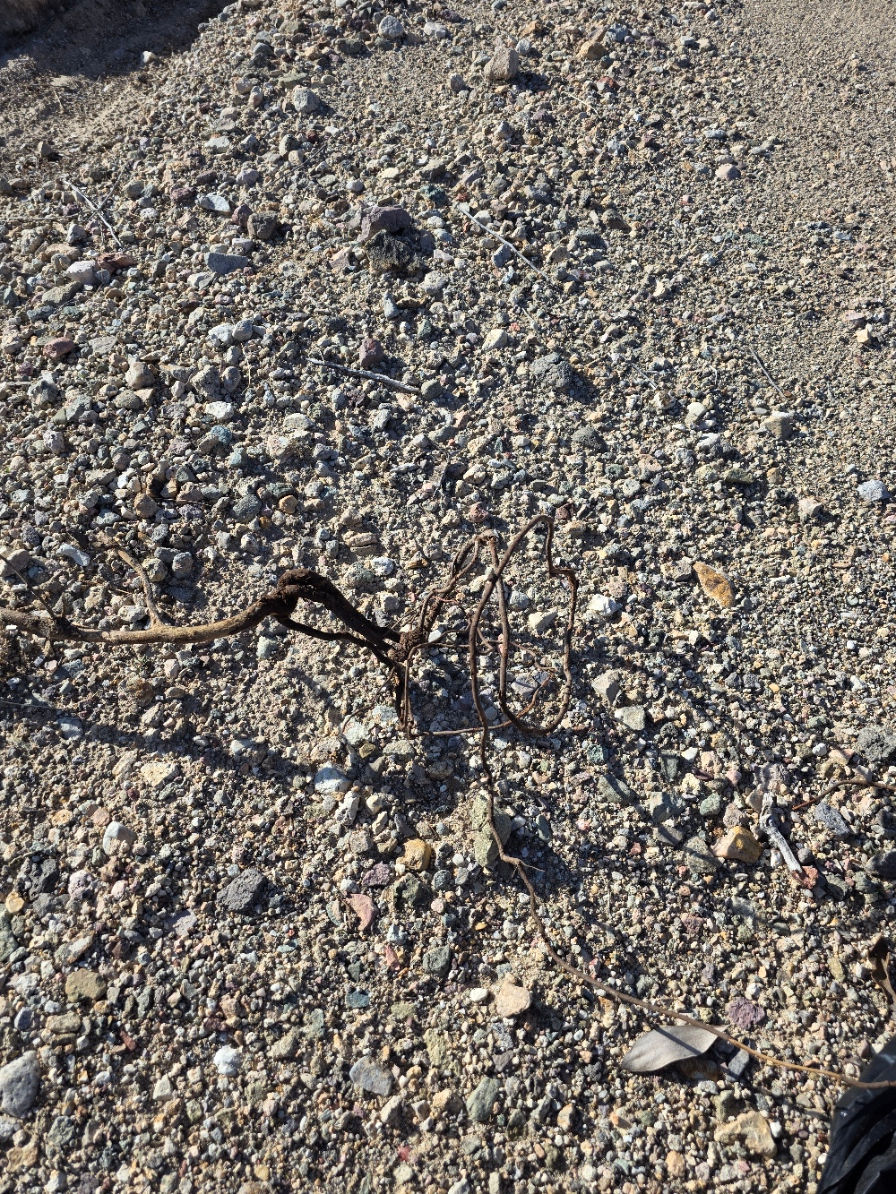
It explained a lot.
It wasn’t that the site “failed” the tree. The tree never truly moved in. It never made that commitment downward into the ground where the real moisture lives and where resilience gets built. It was surviving on whatever it could grab near the surface, and when the heat came hard, that wasn’t enough.
That little root knot was a quiet message: I needed to get these trees in the ground sooner—or at the very least, support them through the summer months with regular waterings. Not heroic floods, just consistent help while they transition. Or provide some artificial shade during the worst of summer, long enough for the canopy and root system to develop before I remove the support I would’ve given them if I could have through that harsh time.
Well, now I know.
Another feather in my cap of knowledge—earned the way most of them are out here: by paying attention after something doesn’t go the way I hoped.
Continued work on the secound earthwork
Next I continued digging the second earthwork and shoring it up with rocks I’d collected on my way out to the land.
This is the hard work. The heavy labor. Everything else out here feels like no work at all compared to this—moving dirt, shaping the basin, setting stone where it matters so the edges hold and the water stays where I’m asking it to stay.
But I’ve developed a rhythm for it.
Ten shovels with my dominant hand, then I switch. Back and forth. Steady. Not fast—just consistent. I find that if I keep it even, my body settles in and stops arguing with me.
I whistle as I work, like I always do out here. It’s part habit, part metronome, part reminder that I’m not in a hurry. I take frequent breaks every twenty to thirty minutes—long enough to breathe, drink, look over what I’ve done, and let the place speak back a little.
That’s what makes it enjoyable.
It’s still heavy. Still real. But it becomes something I can live inside for a while—shovel, rock, tamp, step back, whistle, repeat—until the earthwork starts to look like it belongs.

Settling down for the night
After a long day’s work, I stop about an hour and a half before sunset. That’s my rule out here. If I push right up to dark, I carry that restless energy into the night. If I stop early, I can actually land.
So I start my stretching routine and slowly shift gears—putting tools away, shaking the dust out of my clothes, letting my shoulders drop back into place. The light gets softer, the wind settles, and the whole site feels like it’s exhaling.
Then it’s time to settle down for dinner and the clear, starry night that always comes when the desert decides to be kind.
Late that night, as I’m basking in the glow of my campfire, I catch a few meteors streaking across the sky—quick, silent lines that make you feel small in the best way. Like the work matters, but it isn’t everything.
And when sleep finally comes upon me, I crawl into my sleeping bag.
So comfortable.
As the sun rises, I rise with it—rested and ready to get back to the work of the second earthwork.
I take my time with breakfast, then do a short walk around the property. It’s my way of checking in before I start moving dirt again—seeing what changed overnight, noticing what I missed yesterday, letting the place come into focus.
Then it’s back to it.
I settle into that same steady rhythm and keep at it until the job is finished—wrapped up by about 10 a.m., before the day really starts to heat up.
After that, it’s cleanup, one last look over the work, and I start heading back home around noon.
Conclusion
By the time I’m packing up and taking that last look over the work, I can feel the trip settling into me the way it always does—half satisfaction, half humility.
The land is louder now than it used to be. More birds. More insects. Even a scorpion slipping out of the mulch like it’s been here all along, just waiting for the conditions to be right. That feels like a good sign. Not because everything is “fixed,” but because life is responding. The earthworks are starting to do what they’re meant to do—slow things down, hold water, grow soil, invite the living world back in.
And at the same time, the dead mesquites are a clear reminder that good intentions don’t replace good timing. Seeing those pot-bound roots still coiled up after nearly a year was a lesson I won’t forget. Out here, establishment isn’t optional—it’s everything. If I want trees to make it through the harsh months, I have to either get them rooted before the heat arrives, or I have to commit to supporting them through it with water and shade until they can stand on their own.
That’s the real rhythm of this place: work, observe, adjust. Build something, watch what happens, learn what the land is teaching, and come back a little wiser next time.
So I head home around noon, tired in the good way, already thinking about the next trip—more reinforcement, more planting, more small corrections that add up over time. The fence posts stand a little taller. The second earthwork holds a little stronger. A new mesquite has a better chance than the last one did. And that little volunteer ironwood—protected, encouraged, but not forced—gets to keep writing its own story.
Out here, progress doesn’t shout. It accumulates. Quietly. One shovel at a time. One decision at a time. One season at a time.

Comments