Sleepy Mesquite update 11/5/2025

Return to Sleepy Mesquite (11/5/2025)

I haven’t been back to Sleepy Mesquite since last April. I didn’t plan for it to be that long, but the desert has a way of demanding respect, and life has a way of rearranging your calendar without asking permission.
After my last trip, the illegal dumping activity ceased but the authorities ask that
I stay away till things settle down, and then the heat set in—May rolling into June, June into July, and before I knew it the long stretch from May through September had passed in that relentless way it does out there. The kind of heat that doesn’t just make work uncomfortable, it makes it unsafe. The kind of heat that turns simple tasks into calculated risks. I’ve learned over time that pushing through desert conditions out of stubbornness is not bravery—it’s just bad judgment. So I stayed away, watched from a distance, and waited for a safer window.
But the bigger reason I was gone wasn’t the weather.
In September, my mom’s health took a turn for the worse. What started as concern quickly became crisis, and then became a long hospital stay that took everything we had—time, energy, attention, hope, and prayer. She passed on October 21st. There are no neat words for that. There’s just the reality of it, and the way it changes the air in your lungs and the weight in your chest. Grief doesn’t ask if you’re ready. It just arrives, and it stays.
So when I say I returned to Sleepy Mesquite with bitter sorrow, I mean it. I came back carrying that loss, and I came back because the work still matters. The land is still there. The vision is still there. The family retreat is still there in the bones of the plan, even if my heart is different now than it was the last time I stood on that soil.
This trip still felt like summer in the daytime—upper 80s—though the nights dropped cold the way they do in the desert, like the land is reminding you that comfort is temporary and you’d better be prepared. Over the summer I monitored the Sleepy Mesquite weather remotely, and I could see that the rain had come—real rain—starting in late July and continuing well into October. That alone was enough to stir up excitement in me, because rain is the great revealer. It shows you what your earthworks can do, and it shows you what they can’t. It shows you where water wants to go, and where it refuses to go. It shows you what holds, what fails, and what needs to be built differently next time.
One of my first questions was whether the Bradshaw Trail had taken any new damage. With that much rain, it would have been easy for the trail to get cut up again. But as I checked it, I didn’t see any additional damage from the storms. That was a relief. Out there, access is everything. If you can’t get in, you can’t work. If you can’t work, you can’t improve. And if you can’t improve, the desert will happily reclaim whatever you thought you were building.
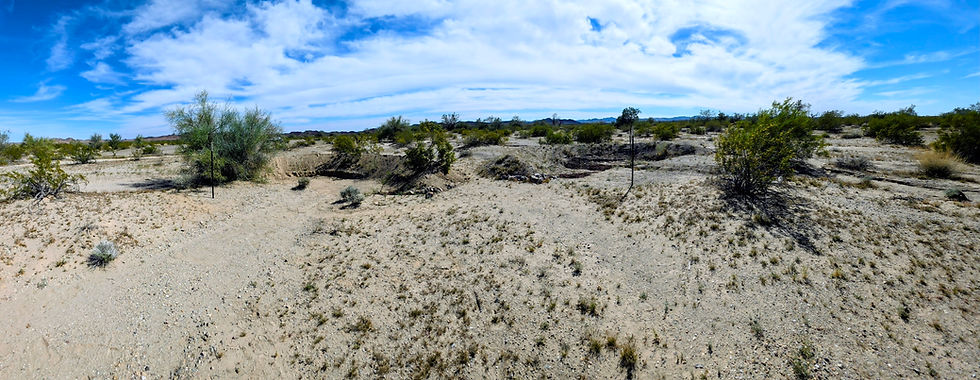
When I finally arrived at Sleepy Mesquite, the land looked much as it had before—same contours, same familiar shapes, same wide-open quiet—but it was greener. Not “lush” the way people imagine when they hear the word green, but green in the desert sense: more life showing itself, more ground cover, more signs that the basin had been drinking. The winter herbal growth had already begun, and that told me the summer rains had been abundant and had continued long enough into fall to shift the timing of what was sprouting.
It’s always a strange feeling to see the land respond when you’ve been away. Part of me felt like I was meeting an old friend again. Another part of me felt like I was walking into a place that had been living its own life without me—which, of course, it had. The desert doesn’t pause because you’re gone. It doesn’t wait for your schedule. It just keeps moving through seasons, storms, heat, wind, and time.
And then I saw what the rain had done to the second earthwork.
So much rain had come that the second earthwork suffered damage similar to what the first earthwork suffered years ago. I stood there looking at it, and I could almost hear the lesson repeating itself: water is patient, and water is strong. It doesn’t need to break things all at once. It just needs enough events, enough pressure, enough overflow, enough repetition. And eventually it finds the weak point.
What surprised me was how little silt had followed into the second earthwork. I expected more deposition, more evidence of sediment being carried and dropped. Instead, it was clear the water had moved through with force, but not with the kind of heavy silt load I imagined. That’s information. That’s data. That’s the land telling me something about how the basin is shedding and holding material.
It has become clear to me that reinforcement of the earthworks should take place early in the construction process—right at the beginning. Not as an afterthought. Not as a “we’ll get to it later.” The desert doesn’t care about later. If you build something and leave it vulnerable, the first real season will test it. And if it fails, you don’t just lose time—you lose materials, you lose structure, and you lose momentum.
As I continued observing, it became obvious that the earthworks had filled several times during the summer, and in fact overflowed multiple times. That’s the kind of thing you can’t fully understand until you see the evidence with your own eyes. Remote monitoring can tell you rainfall totals, but it can’t show you the story written in the mulch, the rocks, the edges, and the way the basin holds itself after repeated events.
In the first earthwork, all the mulch had scattered evenly over the whole basin. At first glance, that might look like a mess. But it also told me something important: the basin had been active. Water had moved through it, lifted and redistributed organic matter, and spread it out. In a way, the basin did what basins do—it caught, it held, it overflowed, and it left behind a more even blanket of material.

The rock reinforcements held perfectly. That was encouraging. They even kept the mulch from flowing out of the basin, which is exactly what I wanted. The rocks did their job. The design held where it was reinforced. That’s the kind of small win that matters, because it means the approach is sound—it just needs to be applied sooner and more thoroughly.
One odd detail: one of the caps to the watering pipes managed to float out of the basin somehow. That’s one of those little things that makes you shake your head. A cap doesn’t seem like much until you realize it’s a point of failure, a point of loss, and a reminder that water will find a way to move anything that isn’t secured.
Then I checked on the trees. Only two of the four trees survived the summer with no additional irrigation over the last seven months. The other two were bone dry. That hit me harder than I expected. I knew it was possible. I knew the risk. But it’s still different when you’re standing there looking at a tree that was alive the last time you saw it, and now it’s brittle and silent.
Still, I’ve seen mesquite trees recover in the past. Mesquite can be stubborn in the best way. They can look gone and then surprise you. So I decided to give them some time to recover, and to see if they bounce back with some extra watering. I’m not calling it either way yet. We’ll find out on the next trip.
The work on this trip was straightforward, practical, and necessary—exactly the kind of work that keeps a project moving even when your heart is heavy.
I placed two more fence posts on the northern boundary and two more on the western boundary. I continued working on the second earthwork, made repairs to it, and began reinforcing it. And I put up fences around the surviving trees to protect them from the rabbits and hares that had chewed them up last spring. Thankfully, there was no further damage to the trees that I could see from the previous visit.
That’s where the day’s work took me—back into the rhythm of building, repairing, observing, and adjusting. The desert doesn’t ask how you’re feeling. It just presents the next task.
And by the time dusk was upon me, it was time to shift from work mode to camp mode.
Dusk, Firelight, and an Unexpected Visitor
By the time dusk was upon me, the light had that familiar desert shift—everything turning softer and flatter at the same time, shadows stretching out, the air cooling fast as soon as the sun started to drop. That’s always the point in the day when I stop pushing. No matter how much I want to “just finish one more thing,” I’ve learned that the desert doesn’t reward that kind of thinking. When the light goes, your margin for error goes up with it.
So I did what I always do. I slowed down, did my stretches, and started settling in for the evening. There’s a routine to it: get the fire going, get dinner started, get everything in its place before it’s fully dark. Out there, a simple routine isn’t just comfort—it’s safety. It keeps you from misplacing tools, stepping wrong, or fumbling around when you should be paying attention.
I got the fire going and started dinner, and for a few minutes it was peaceful in that way the desert can be—quiet, steady, almost like the land is exhaling. The firelight made a small circle of warmth and familiarity, and everything beyond it felt like the wide, watchful dark.
Then, right as I was getting ready to eat, the fire attracted an unexpected guest.
A baby rattlesnake—about a foot and a half long—came right into camp and parked itself next to my foot like it owned the place. Just slid in and settled down, calm as you please, and started surveying the area. If I hadn’t been paying attention, that could have gone very bad, very fast.
When I noticed it, I froze. Not the dramatic kind of freeze—more like the quiet, controlled kind where your body decides for you that you’re not moving another inch until you understand exactly what’s happening. I stayed in my chair, peering down every few seconds to see if it had moved on yet, trying not to make any sudden motions. And the little guy just stayed there. For a good five minutes it remained nestled next to my foot, no doubt warming itself by the fire and scanning the camp for prey. I remember thinking, in a strange way, how “reasonable” it looked—like it had simply found a good spot and was taking advantage of it. That’s the thing about wildlife encounters: they’re not personal. The snake wasn’t there to “get me.” It was there because the fire was warm, the night was coming, and the desert runs on instincts that are older than any of us.
Still, I’ll be honest—my heart was working overtime.
I’ve worked with animals and reptiles for the last 40 years, and that experience kicked in immediately. Don’t panic. Don’t flail. Don’t try to be a hero. Just stay calm, stay still, and give the animal space to do what it’s going to do. The desert is full of lessons, but one of the biggest is this: you don’t win by escalating. You win by respecting what you’re dealing with.
Eventually, the snake decided it was done with my campfire hospitality. It finally moved on and went under my car. Before it disappeared, I took a quick picture—partly because I couldn’t believe what had just happened, and partly because it’s the kind of moment you want to remember later, when you’re safely back home and your nerves have stopped buzzing.

That could have been very bad. Instead, it was a reminder—one more reminder—that Sleepy Mesquite is not a backyard project. It’s real land, with real weather, real consequences, and real creatures that don’t care about your plans.
Needless to say, I kept a lookout for it for the rest of the night until I retired. I didn’t let that firelight lull me into forgetting where I was. I checked the ground, checked around the car, and stayed aware of where I put my feet. The desert is beautiful, but it’s not sentimental.
And I’ll say this too: as I sat there that night, I couldn’t help but feel like I had company in more ways than one. The Lord and Mom were no doubt watching over me tonight. I don’t say that lightly. It was one of those moments where you feel the thinness between “fine” and “not fine,” and you realize how quickly things can change—and how grateful you are when they don’t.
The following day, I continued finishing up the work as far as I could, and then headed home at my usual time of 10am. That’s another rule I don’t break: get out before the day heats up, and leave enough time to travel safely. The work will still be there next time. The land will still be there. And if I do this right, I will be too.
Memorial + Conclusion Summary
Before I close this update, I want to add something that matters to me, and to the reason I keep coming back out here.
In loving memory of my mom, who passed on October 21st—your love, strength, and faith are carried into this land and this work.
Grief has a way of changing the meaning of a place. Sleepy Mesquite is still the same desert property it was last spring, but I’m not the same person walking it. This trip wasn’t just a return to unfinished projects—it was a return to purpose, at a time when it would be easy to go numb and let everything sit. Instead, I came back and took the next steps, even if they were small, even if my heart wasn’t fully in “building mode” yet. And the land, in its own way, met me there.
The summer rains brought more green than I expected to see this late in the year, and they also tested the earthworks in a way that gave me valuable information. The first earthwork showed that the rock reinforcement approach works—holding structure and keeping mulch from washing out, even through multiple fill-and-overflow events. The second earthwork, on the other hand, made it clear that reinforcement can’t be treated as optional or postponed. If I want these systems to last, they need to be strengthened early, before the desert gets its turn to “review” the work.
The trees also told their story. Two survived seven months without additional irrigation, and two did not—at least not yet. I’m not writing the other two off completely, because mesquite can surprise you, and I’ve seen recovery happen before. Next trip will tell me more once they’ve had time and a little extra water.
On the practical side, this visit moved the project forward in the ways that matter:
Boundary progress with additional fence posts on the north and west sides
Repairs and early reinforcement started on the second earthwork
Protective fencing installed around the surviving trees to prevent further rabbit and hare damage
And then there was the reminder that Sleepy Mesquite is always going to be real desert work: the baby rattlesnake by the fire. A close call, a lesson in awareness, and—if I’m being honest—one of those moments that felt like a warning and a blessing at the same time. I’m grateful it ended the way it did.
I left the next morning at my usual 10am, with the work as finished as I could get it for this trip, and with a clearer sense of what needs to happen next. The desert doesn’t respond to intentions—it responds to what you build, what you reinforce, and what you return to, again and again.
This is still the work: greening the desert, building the family retreat, and learning the land one season at a time.

Comments