
Why I'm Focusing on the First Earthwork?

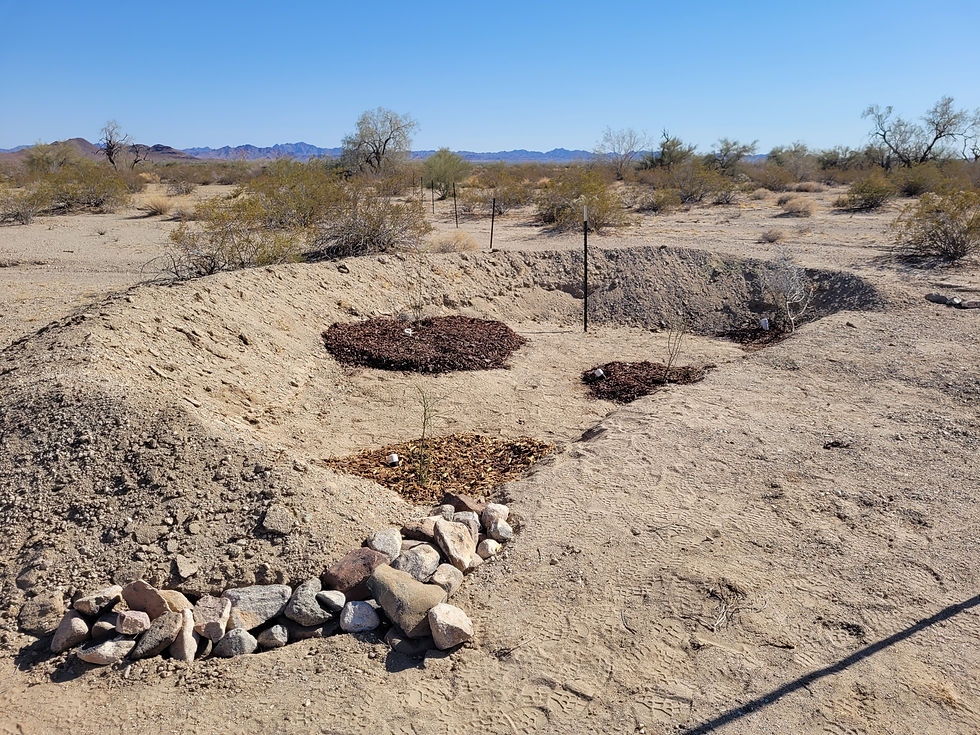
Why I’m Focusing on One Earthwork Instead of Building Them All at Once
When people hear that I’m working on a dryland permaculture project, they often picture big, sweeping transformations: swales carved across the hillsides, terraces stepping down the slope, earthworks everywhere you look, and a forest of young trees springing up almost overnight.
The reality at Sleepy Mesquite is much slower, and far more intentional.
Right now, my primary focus is on the first earthwork. Not on building as many as I can, as fast as I can, but on refining this one: its shape, its function, how it behaves in real conditions, and how I work with it.
This choice is deliberate. In a landscape as exposed and unforgiving as Sleepy Mesquite—triple‑digit heat, unpredictable water, strong winds, stressed young trees, and human pressures like illegal dumping—rushing into large‑scale earthmoving doesn’t feel like ambition. It feels like a way to multiply mistakes.
I would rather make my mistakes small, early, and instructive.
This post is about why I’m resisting the temptation to “do it all” right now, and choosing instead to perfect the design, the labor, and the construction processes around a single earthwork before I replicate it across the land.
The Temptation to Build Everything at Once
Standing on bare, dry ground, it’s incredibly easy to start drawing mental lines everywhere: a swale here, a berm there, a series of basins over there, a future pond at the bottom, trees aligned along contours, understory plants filling in all the gaps. If you’ve ever looked at a permaculture design map, you know how fast your imagination can go.
In my mind, all of Sleepy Mesquite is already patterned with earthworks.
The temptation is to jump straight into “full deployment”: carve in all the swales, heap up all the berms, dig all the basins, and plant everywhere in one great push of enthusiasm. In cool weather, with abundant water and easy access to materials, that might be simply ambitious. In this context—a dry, hot, wind‑exposed landscape where 103°F in “spring” is becoming normal—that approach would be reckless.
Out here, every earthwork is a commitment:
- To maintain it
- To plant around it
- To understand how it changes the microclimate
- To be physically present enough to support it through extreme heat, wind, and irregular rain
If I carve ten new earthworks into the land before I fully understand how the first one behaves, I’ve just multiplied my uncertainties by ten.
Why One Earthwork Matters More Than Ten
It might look like “not much is happening” when most of the work is focused on a single earthwork, but there is a deeper strategy behind that slower pace.
By concentrating on one earthwork, I can:
1. **Refine the design**
2. **Refine the construction process**
3. **Refine the labor rhythm and safety practices**
4. **Observe how it actually behaves in real conditions over time**
5. **Let that feedback shape everything that comes after**
This approach respects the reality that the land and the climate will always have the final say. No matter how much permaculture theory, mapping, and planning I do, Sleepy Mesquite itself is the real teacher. One properly observed earthwork can shape the entire design vocabulary for the rest of the site.
Let me unpack some of the variables that go into that first earthwork and why I’m treating it as a prototype instead of a finished product.
Variable 1: Wind and Sun Directions
The first time I sheltered under an Ironwood tree on a 103°F day and felt a roughly 15‑degree temperature drop under the canopy, it drove home something I already knew but hadn’t yet fully internalized: microclimate is not a theory—your body feels it.
The way an earthwork is placed relative to wind and sun patterns can dramatically influence:
- Evaporation rates
- How much protection young plants receive
- Where shade falls throughout the day and year
- How much reflected heat bounces off bare soil or rock and onto tender vegetation
- How comfortable or dangerous it is for a human working nearby
Wind
Wind doesn’t just “blow.” It shapes the entire moisture budget of a landscape like this. A poorly placed earthwork can:
- Channel wind and accelerate drying
- Expose seedlings and young trees to desiccating gusts
- Undermine the stability of loose soil and mulch
By focusing on the first earthwork, I’m watching how winds actually move across the land:
- Which direction are the prevailing winds really coming from at different times of year?
- How does that interact with small rises, dips, and existing vegetation?
- Does the berm side of the earthwork offer a true wind break, or does it create turbulence and swirling patterns that might damage plants?
You don’t see all of this in the first week, or even the first month. You see it by coming back, again and again, in different seasons, under different conditions. That’s why I don’t want to replicate the same pattern ten times before I understand this first one.
Sun
In a place where spring days can hit 103°F, sun exposure isn’t just about “full sun” versus “part shade” in a plant catalog. It’s about survival.
The first earthwork is giving me a working laboratory to ask:
- How does the angle of the berm cast shade at different times of day?
- Does the orientation help cool the soil in the hottest part of the afternoon?
- Are there spots that remain hot and reflective all day long, where more mulch, rocks, or shade trees are essential?
- How do existing Ironwood trees and other plants interact with the earthwork in terms of shade and shelter?
By starting with one, I can position trees and shrubs around it in a way that is directly informed by experience, instead of theory alone. Over time, when I stand in those shaded spots on hot days, I’m going to feel the design working—or not—and that will shape what I do next.
Variable 2: Water Flows Across the Landscape
In dryland permaculture, water is everything—how it arrives, how it moves, where it stagnates (if it ever does), how fast it leaves, and whether you can persuade it to stay even a little bit longer.
On paper, I can look at contour maps, visible slopes, and soil types and come up with a reasonable plan for where to place earthworks. But actual water, moving through real soil under real storms, is rarely as neat as the lines on a map.
The first earthwork is my test case for how this land actually handles water.
I’m watching:
- When it rains, does the earthwork capture runoff as expected, or does it overfill, breach, or bypass?
- Are there unexpected flows coming from directions I hadn’t fully accounted for?
- Does the soil behind the berm stay moist for longer than the surrounding areas? How much longer?
- Are there erosion spots that show up along the edges or in the channels leading into the earthwork?
If I build out an entire network of earthworks before I answer these questions, every miscalculation is multiplied across the system. That’s a lot of shovel‑hours invested in correcting what I could have learned from one carefully built and observed structure.
Water is patient, but it is also relentless. It will show you, over time, how it wants to move. My job is to listen.
Variable 3: Plant and Tree Selection
Every earthwork is not just a “hole and a hill.” It’s a future planting zone. The microclimate around that structure will be different from the surrounding land, and that difference is what allows certain plants and trees to survive that otherwise couldn’t.
But which plants, and in which exact spots?
That’s not something I want to guess about ten times in a row.
On this first earthwork, I’m watching:
- Which species can tolerate the reflected heat and wind at the top of the berm?
- Which do better in the slightly moister, more protected basin?
- How do roots respond to the compacted versus loosened soils?
- Do certain species suffer more when the heat spikes early in the season, as it did this year?
- How much mulch is enough, and how deep is too deep in this specific soil profile?
On previous visits, I’ve seen trees drop their leaves under heat stress, leaving me wondering which will come back and which won’t. Those observations feed into plant selection and placement around this earthwork.
I’m not interested in just “keeping plants alive.” I want to curate a community:
- Trees that provide real shade, like the Ironwood, which clearly demonstrated a 15‑degree temperature difference under its canopy.
- Support species that stabilize soil, add organic matter, and help nurse more sensitive species into maturity.
- Deep‑rooted species that can mine moisture and nutrients from deeper layers and make them available at the surface.
If I rush to plant dozens or hundreds of trees and shrubs around multiple earthworks without learning from this first one, I’m likely to repeat bad choices—wrong species, wrong placement, wrong mulch pattern, wrong irrigation intervals—on a much larger scale.
Variable 4: The Human Body and the Labor Process
This is a piece that often gets overlooked in design discussions but has become central to my thinking at Sleepy Mesquite: my own body.
On one of my recent trips, the temperature hit 103°F. The trees weren’t the only things under stress.
I brought strips of cotton fabric to wet down and place around my neck and under my hat. That simple adaptation made a huge difference in how long I could work, and how safe I felt doing physically demanding tasks like digging, hauling rocks, and lifting fence posts.
This trip was a reminder that:
- The design has to match the capacity of the human tending it.
- Heat management isn’t optional; it’s part of the design brief.
- Labor processes need to be structured to respect the climate: early starts, strategic rest, conscious shade‑seeking, and a willingness to stop before the land stops “needing” you.
By focusing on one earthwork, I’m also learning:
- How long does it really take to dig and shape a structure of this size in these conditions?
- What tools and sequences work best to minimize strain and maximize efficiency?
- How does my body respond to working in this specific environment—heat, glare, dust, wind—over the span of a few hours?
This is not an abstract concern. If I try to build five earthworks in one season and push my body too far, I’m not just risking burnout—I’m risking injury or heat illness, especially when I’m alone on site.
That’s not heroic, and it’s not sustainable.
By using this first earthwork as a test case, I can refine my own working patterns:
- What time should I arrive on site?
- What time is my non‑negotiable cutoff, no matter how tempting it is to “just do a little more”?
- How do I structure tasks so that the most strenuous pieces are done in the coolest part of the morning?
- Where do I need permanent or temporary shade structures, in addition to trees, to make this a place I can responsibly work in the long term?
The Role of Observation Over Time
If I had to name the core principle behind focusing on this first earthwork, it would be this: **observation over time is more valuable than rapid construction.**
Permaculture talks a lot about “observe and interact.” It’s easy to nod along with that idea and still rush ahead with building, because building feels like progress. But on a site like Sleepy Mesquite, where so many variables are extreme or shifting—heat, wind, rainfall, human activity—observation isn’t a preliminary step; it’s an ongoing practice.
What Observation Looks Like Here
Observation in this context is not just “looking around.” It’s:
- Returning in different seasons and at different times of day
- Noticing where the soil stays moist longer after a rare rain
- Standing under an Ironwood at peak heat and feeling the difference in your skin and breathing
- Watching which trees drop their leaves under stress and which hold on
- Listening for wind patterns and noting how they change with subtle shifts in topography
- Tracking how long the earthwork holds water—if and when water comes at all
On one trip, observation took the form of noticing the illegal dumping nearby—massive dump trucks leaving piles of scrap construction materials nearly ten feet high and covering almost two acres. That wasn’t “part of the plan,” but it absolutely informs how I think about safety, access, and long‑term stewardship of this place. It’s one more layer of reality that observation uncovered.
Observation as a Design Tool
Over time, all of these observations feed back into design decisions about:
- Earthwork placement and size
- Tree and plant selection
- Mulch depth and type
- Where and how to work safely in high heat
- When to arrive and leave
- Where to prioritize shade creation—both plant and man‑made
The first earthwork becomes a living notebook. Every crack, puddle, dry patch, wind‑scoured edge, and thriving pocket is a piece of information I can use.
Instead of treating the design as something I must get “right” all at once, I let the land write back to me through this one structure. That requires patience—but it also prevents me from pouring time and energy into patterns that don’t actually match the reality of the site.
Why “Perfecting the Process” Matters More Than “Finishing the Site”
When I say I want to “perfect the design and the labor and construction processes,” I’m not aiming for some flawless, unchanging blueprint. What I want is a process that is:
- Responsive to observation
- Grounded in real, lived experience of the climate and the land
- Scaled to my actual capacity, not my fantasies
- Resilient enough to adapt to surprises—like early heat waves or illegal dumping next door
Design Process
“Perfecting” design here means:
- Testing assumptions on a small scale
- Adjusting the shape, depth, and orientation of the earthwork based on how it behaves over time
- Iterating on planting schemes as I see which species truly earn their place in these conditions
- Integrating lessons from each extreme event—heat spike, wind storm, or rare rain—back into the pattern
Labor Process
“Perfecting” labor means:
- Finding ways to pace myself that allow for consistency over years, not just bursts of effort in good weather
- Using simple tools and supports (like wet cotton strips, shade breaks, and smart task sequencing) to work with the climate, not against it
- Accepting that some days will be shorter than I had planned, and that leaving early—for example, heading out at 2 p.m. at the peak of a brutal heat wave—is not a failure, but a necessary strategy
Construction Process
“Perfecting” construction means:
- Learning which combinations of rock, soil, and mulch stabilize best under wind and occasional runoff
- Resolving small failures now—minor erosion, slumping berm edges, poorly compacted sections—before scaling up
- Using the first earthwork as a reference pattern, so future ones can be built more efficiently and more effectively from the start
When I eventually move on to constructing additional earthworks, I want each shovel of soil I move to be informed by everything I’ve learned here, not just by something I saw in a book or online.
Scaling With Wisdom, Not Just Enthusiasm
At some point, there will be more earthworks at Sleepy Mesquite. More shaped landforms capturing and holding what little water comes through. More trees, more shade, more life.
But I want that expansion to be guided by wisdom earned on the ground, not just by enthusiasm or impatience.
By the time I begin the third or fourth earthwork, I want to:
- Know where the wind really comes from in July, not where I guessed it came from in March.
- Have a shortlist of tree and shrub species that I’ve seen withstand early triple‑digit heat and come back strong.
- Understand how long the soil behind a berm stays moist under typical conditions here.
- Have a set of personal working guidelines that keep me safe, hydrated, and able to return trip after trip.
If I can get those things dialed in on this first earthwork, then each additional one becomes less of a gamble and more of a confident step toward a coherent, resilient system.
The Quiet Power of Doing Less, Better
In a world that rewards speed, visibility, and “big reveals,” it can feel countercultural to say: I am working slowly, and I am focusing on just one earthwork right now.
But this is the pace that feels honest to the climate, the land, and my own body.
That first earthwork is not just a structure in the ground. It’s:
- A training ground for my skills
- A living lab for understanding water, heat, wind, and plant choices
- A place where I test strategies for working safely in extreme conditions
- A record of how this particular corner of desert responds to being invited into a different pattern
By choosing to refine this one carefully instead of scattering my efforts across many, I’m investing in the quality of everything that follows.
Sleepy Mesquite is not a project I’m trying to “complete.” It’s a relationship I’m building over time. And like any relationship worth having, it asks for patience, attention, and a willingness to listen more than I speak—or in this case, to observe more than I build.
The earthworks will come. For now, it starts here, with one. As posed to building as many of them as I can as fast as possible?

Comments